|
World's Intact Forest Landscapes, 2000-2025
Download the IFL dataset
Key Findings
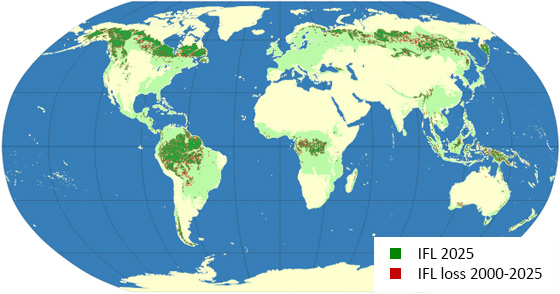
The area of IFLs remaining in 2025 is 1086.2 Mha, which makes up only 8.4% of the Earth’s ice-free land area and includes 21% of the global tree cover. The largest tracts of intact forests are found in the Amazon and Congo River basins and in the northern boreal forests. Eleven countries (Brazil, Canada, Chile, Colombia, the Democratic Republic of the Congo, Indonesia, Papua New Guinea, Peru, Russia, the United States, and Venezuela) host more than 90% of the global IFL area. Most other countries that still retain IFL areas have only a small portion of their forests intact.
From 2000 to 2025, the global IFL area declined by 194.7 Mha (15.2%), an area nearly equivalent to the land area of Mexico. The largest absolute IFL losses occurred in tropical South America and the boreal regions of Eurasia and North America, which accounted for 34%, 28%, and 18% of the total area reduction, respectively. During this period, Romania lost all its IFLs, while Nicaragua, Paraguay, and Solomon Islands lost >75% of their IFL area. The Central African Republic, Equatorial Guinea, Honduras, Laos, and Liberia lost more than half of their IFL area.
The average rate of IFL reduction during 2000-2025 was 8.1 Mha per year, equivalent to about 22,000 ha per day. The rate of IFL area reduction increased over time from 7 Mha per year before 2013 to 10 Mha per year after 2020. Over the last eight years, Russia experienced the largest increase in the annual IFL loss due to logging, oil and gas extraction, mining, and forest fires associated with industrial infrastructure. Other countries with substantial increases in annual IFL loss include Bolivia, Brazil, Canada, Colombia, the Democratic Republic of Congo, Suriname, and Venezuela.
We project that the global year 2000 IFL area will be reduced by half by the 2080s. Temperate regions of North America and Eurasia may lose half of their year 2000 IFL area even sooner, by the 2050s. Australia, Bolivia, Cameroon, and Madagascar may lose half of their year 2000 IFL by 2030; Gabon, Guatemala, Myanmar, and Nigeria by 2040; and the Republic of the Congo by 2045. We further project that nine countries (the Central African Republic, Guatemala, Honduras, Liberia, Madagascar, Nepal, Nicaragua, Nigeria, and Solomon Islands) may lose all their IFLs by 2060. Given the importance of forest wildlands for carbon storage and sequestration, such IFL loss will substantially reduce the natural potential to mitigate climate change. The loss of forest wildland habitat will inevitably lead to species extinctions at an unprecedented level and will increase the vulnerability of the forest-dwelling Indigenous cultures to climate change, disease, and malnutrition.
Conservation of Intact Forest Landscapes is a matter of global importance. Our analysis shows that protected areas are the most effective mechanism for reducing IFL loss, whereas forestry certification systems, such as FSC, are ineffective. New and existing infrastructure development, timber harvesting, and mineral resource extraction should avoid fragmentation of remaining IFLs. Indigenous Peoples’ rights should be recognized and upheld to support their active contribution in preventing the industrial degradation of remaining forest wildlands. Given that the remaining IFL area is far below the "30x30" conservation target of the United Nations Convention on Biological Diversity (CBD), IFLs should be prioritized when existing protected area networks are revised and expanded, or in the recognition of Other Effective Area-Based Conservation Measures (OECMs) are considered.
The latest IFL map update for the year 2025, the analysis of the IFL loss drivers, and the projection of the future IFL area change have been published on Zenodo.
|
|
|